
Comparison of AToS with selected approaches
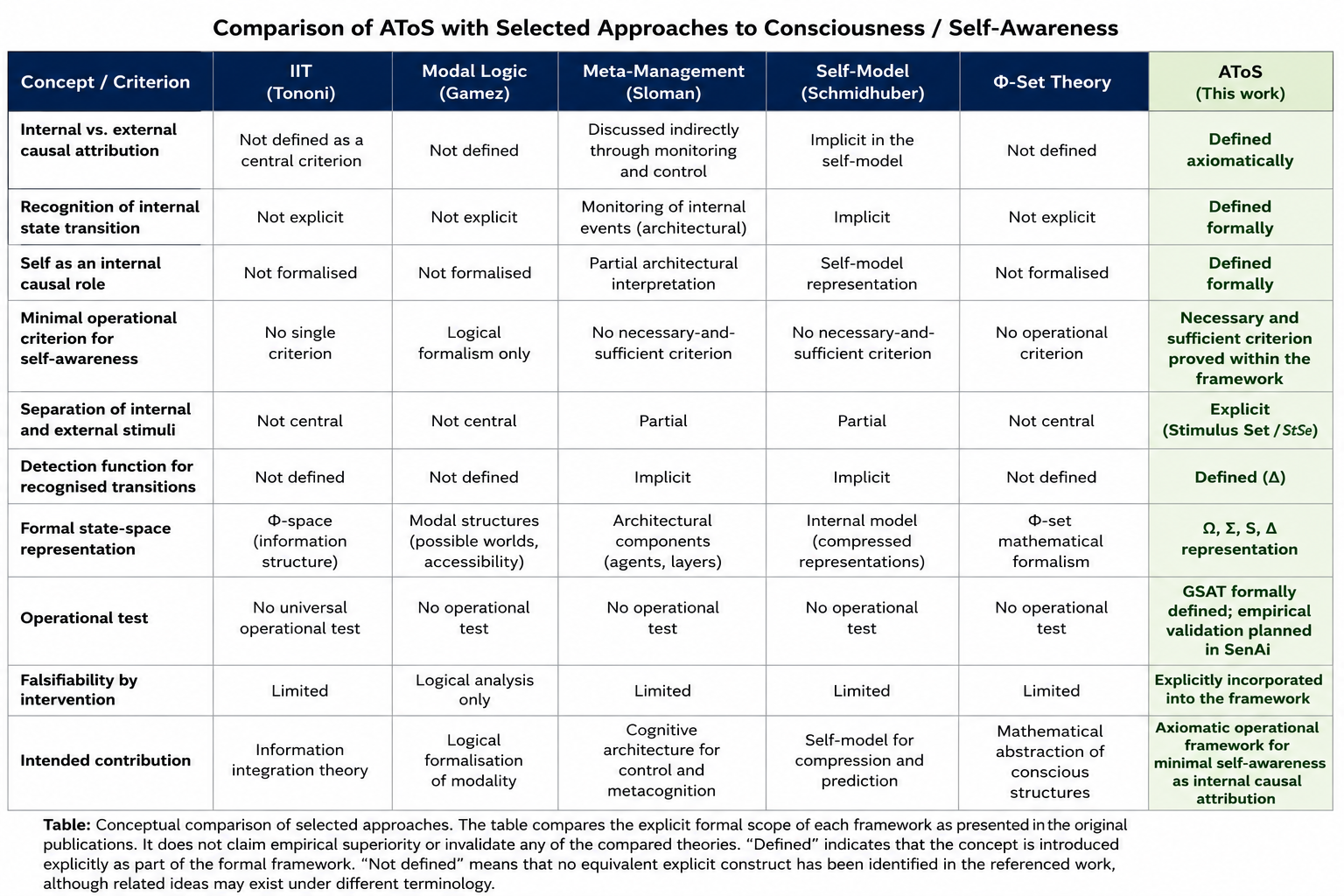
| Concept / criterion | IIT (Tononi) | Modal Logic (Gamez) | Meta-Management (Sloman) | Self-Model (Schmidhuber) | Φ-Set Theory | AToS (this work) |
|---|---|---|---|---|---|---|
| Internal vs. external causal attribution | Not defined as a central criterion | Not defined | Discussed indirectly through monitoring and control | Implicit in the self-model | Not defined | Defined axiomatically |
| Recognition of internal state transition | Not explicit | Not explicit | Monitoring of internal events (architectural) | Implicit | Not explicit | Defined formally |
| Self as an internal causal role | Not formalised | Not formalised | Partial architectural interpretation | Self-model representation | Not formalised | Defined formally |
| Minimal operational criterion for self-awareness | No single criterion | Logical formalism only | No necessary-and-sufficient criterion | No necessary-and-sufficient criterion | No operational criterion | Necessary and sufficient criterion proved within the framework |
| Separation of internal and external stimuli | Not central | Not central | Partial | Partial | Not central | Explicit (Stimulus Set / StSe) |
| Detection function for recognised transitions | Not defined | Not defined | Implicit | Implicit | Not defined | Defined (Δ) |
| Formal state-space representation | Φ-space (information structure) | Modal structures (possible worlds, accessibility) | Architectural components (agents, layers) | Internal model (compressed representation) | Φ-set mathematical formalism | Ω, Σ, S, Δ representation |
| Operational test | No universal operational test | No operational test | No operational test | No operational test | No operational test | GSAT formally defined; empirical validation planned in SenAi |
| Falsifiability by intervention | Limited | Logical analysis only | Limited | Limited | Limited | Explicitly incorporated into the framework |
| Intended contribution | Information integration theory | Logical formalisation of modality | Cognitive architecture for control and metacognition | Self-model for compression and prediction | Mathematical abstraction of conscious structures | Axiomatic operational framework for minimal self-awareness as internal causal attribution |
Conceptual comparison of the explicit formal scope of each framework, as presented in the original table. It does not claim empirical superiority or invalidate the compared theories. “Defined” indicates inclusion as part of the formal framework.